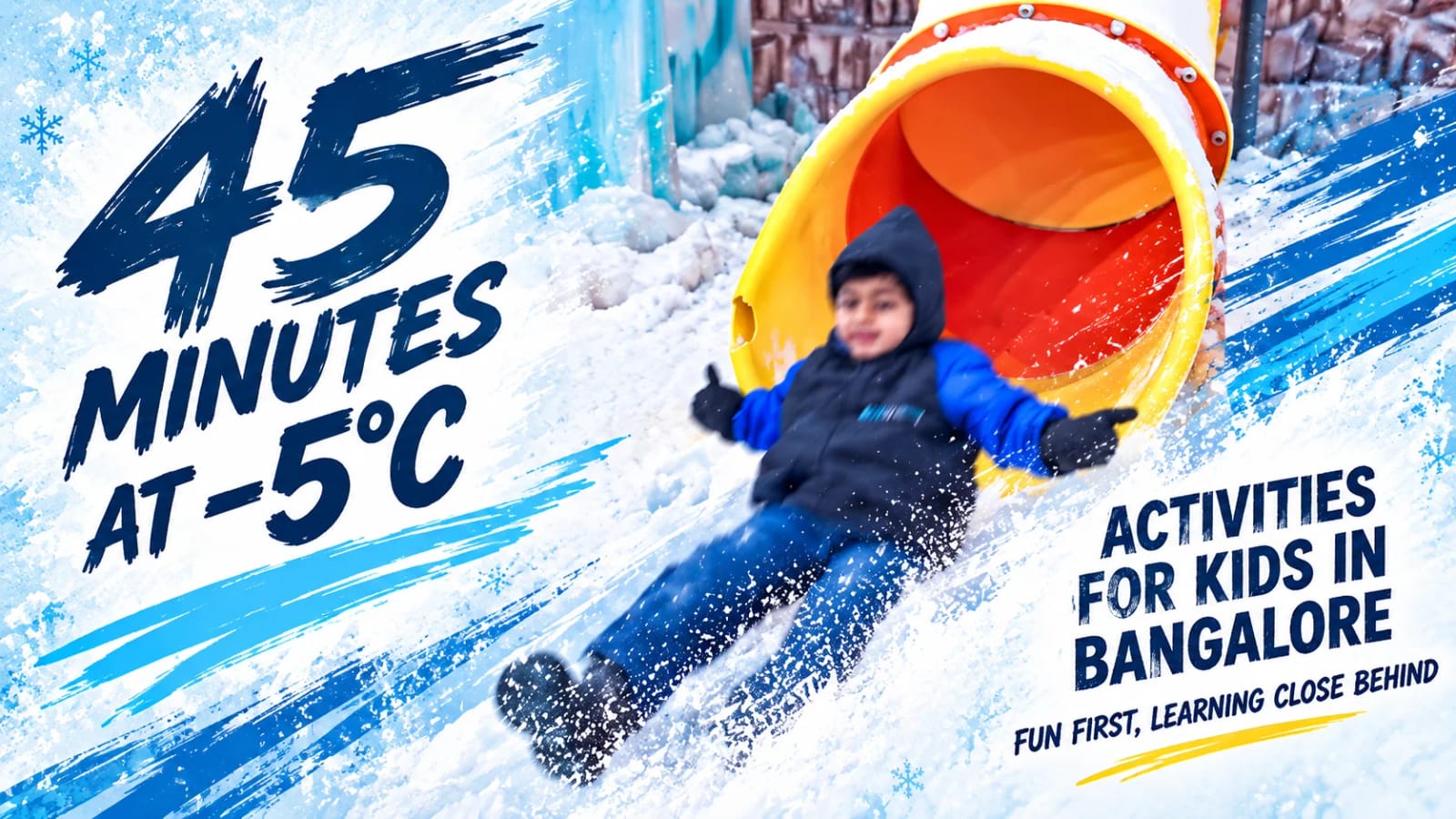
Parents choosing activities for kids in Bangalore usually sort them into two piles. The fun ones the child wants, and the educational ones the parent wants, with a long car ride of negotiation in between.
Snow breaks that split better than most activities for kids in Bangalore. A November afternoon in the city sits in the mid-to-high twenties Celsius, and stepping into a snow zone at −5°C is a temperature drop of more than thirty degrees in a single doorway.
A child's body notices that before their mind does. What happens in the next forty-five minutes is one of the more quietly educational activities for kids in Bangalore, as long as a parent knows what to look for and which questions to ask on the drive home.
Why Snow Counts Among Educational Activities for Kids in Bangalore
Snow play teaches through the body first: temperature, friction, balance and the way water changes state. A child who has slid, fallen, packed a snowball and watched it melt in a glove has met several middle-school science ideas physically, which makes them far easier to understand when they turn up later in a textbook.
This is not a claim that a snow session replaces a lesson. It is a claim that it gives the lesson something to attach to.
Children remember what they felt. The textbook line about water turning to ice lands differently for a child who has held a fistful of snow and watched it turn back into water in the car park.
The 45 Minutes, Broken Down
A snow session at Snow City in JC Nagar runs for roughly forty-five minutes. Here is what tends to happen inside that time, and what each moment is quietly teaching.
| Moment in the session | What the child is doing | What they are learning |
| First 2 minutes | Gasping at the cold, checking gloves | How the body reacts to sudden cold, and why layers matter |
| Minutes 3–10 | Walking carefully, slipping, adjusting | Balance and grip on a low-friction surface |
| Minutes 10–25 | Snow slides and snow rafting | Speed, friction and the effect of slope |
| Minutes 25–35 | Snowball fights with siblings or friends | Throwing technique, fair play and taking turns |
| Minutes 35–45 | Packing snow, watching it change | States of matter: snow, ice and water |
The cold itself
The snow zone is kept between −5°C and −7°C, and the first thing most children do is hug themselves. That reaction is the lesson. They feel why the jacket, gloves and boots matter, and they learn it in a way no "wear your sweater" instruction ever managed.
Sliding and slipping
Snow slides and snow rafting turn friction from a word into a feeling. Children notice they go faster on a smoother run and slower when they drag a hand, and they begin adjusting without being told.
Snowball fights
A snowball fight is a small society. Children negotiate teams, agree on rules, decide what counts as fair, and learn very quickly what happens to someone who throws at faces. It is social learning disguised as chaos.
Holding the snow
Snow at Snow City is made from RO water, so curious children can safely taste it. Most will pack it, squeeze it and watch it soften in a gloved hand, which is the melting point lesson before anyone has named it.
A child does not need to be told snow is frozen water. They need forty-five minutes of holding it, and one good question afterwards.
The Questions to Ask on the Drive Home
The learning sticks when a child puts it into words. Skip the quiz and ask questions that sound like conversation.
- "Why do you think your face felt cold but your body didn't?" This opens a chat about insulation and layers.
- "Which slide was faster, and why?" Children will usually work out that smoothness and slope matter.
- "What happened to the snow in your glove?" The answer leads naturally to melting and freezing.
- "Where does real snow come from?" A doorway to weather, clouds and mountains.
- "How would you build a fridge for an entire room?" A playful way into how the snow zone works at all.
- "What was the fairest rule in the snowball fight?" The social lesson, recognised out loud.
Ask two or three, not all six. The goal is curiosity, not homework.
Extend the Learning at MAD Labs
Snow City's neighbour, MAD Labs, picks up where the snow leaves off. It has more than forty hands-on science zones built by a team out of IISc and NUS, and children learn by pulling, pushing and testing rather than reading.
The pairing works because the order suits a child's energy. The snow comes first, when they are bursting to move, and MAD Labs comes second, when they are warm, calmer and ready to tinker.
- Younger children tend to enjoy the cause-and-effect zones, where pressing or pulling something produces an instant result.
- Older children go further into why the result happens, and can spend much longer at a single exhibit.
- Siblings of different ages can work in the same room at different levels, which removes the usual waiting.
- Parents can join in without needing to know the answers, which is part of the fun.
Eyelusion's illusion sets add one more angle. Optical illusions are a gentle introduction to how the brain interprets what the eyes see, and children love catching the trick.
Planning the Visit
| Detail | What to know |
| Location | Jayamahal Main Road, opposite the TV Tower, JC Nagar, next to Fun World |
| Timings | 10 AM to 8 PM, every day |
| Snow Park | From ₹500 per person, jacket and boots included |
| Snow Park + MAD Labs combo | ₹900 per person |
| All-inclusive with Eyelusion | ₹1,200 per person |
| Time to allow | 3 to 4 hours for the combo |
| What to wear | Jeans, full sleeves, socks, plus a spare pair |
Confirm current rates and book a slot on snowcityblr.com before visiting. A few small choices make the learning side of the day work better:
- Book a morning slot, when children are fresh enough to notice details rather than just survive the excitement.
- Skip the phone during the session. Phones and cameras are restricted in the snow zone anyway, so the child gets your full attention.
- Let them lead in MAD Labs. Follow their curiosity rather than steering them to the exhibit you find interesting.
Keep one question for bedtime. "What surprised you most today?" often gets the best answer of the day.
Key Takeaways
- Snow play teaches temperature, friction, balance and states of matter through the body first.
- A November afternoon to a −5°C snow zone is a drop of more than thirty degrees, and children feel every one.
- The learning sticks when children explain it, so ask two or three conversational questions on the drive home.
- Pair the snow session with MAD Labs, snow first and science second.
- Book on snowcityblr.com and allow three to four hours for the combo.
Fun First, Learning Close Behind
The most useful activities for kids in Bangalore do not ask children to choose between enjoying themselves and learning something. They put the learning inside the enjoyment, and let a parent's questions bring it out afterwards.
Forty-five minutes at −5°C, a few good questions in the car, and a child who will understand melting points better than any worksheet could have managed. Book a session at snowcityblr.com or call 78295 50000.
📩 DM us: @snowcitybangalore
📍 Visit us: Snow City, Jayamahal Main Road, Opp. TV Tower, JC Nagar, Bengaluru
🔗 Book Now: snowcityblr.com
📞 Call: 78295 50000